
Choosing Board Thickness by Load: 21 mm and 18 mm
Choosing the right thickness for an economical formwork panel is a trade between load, reuse and cost. Dongstar Wood's ordinary black film faced plywood is published at 21 mm as the most requested thickness for European buyers, followed by 18 mm, with 1250 × 2500 mm the most common format and a melamine-bonded acacia core tested through a 10 Hours Boiling Test.
Key takeaways
- 21 mm is the most requested thickness for European buyers; 18 mm is the second.
- 1250 × 2500 mm is the most requested format for the panel.
- The core is acacia from Vietnam plantation forests, bonded with melamine adhesive.
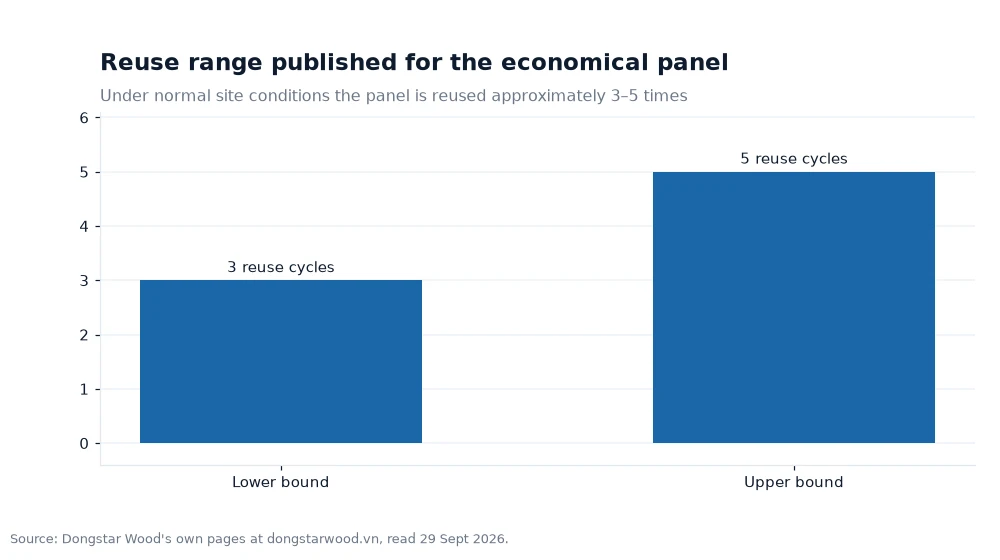
- Under normal site conditions the panel is reused approximately 3–5 times.
How load drives thickness
Thickness is the variable that keeps a formwork panel flat under a pour. The more concrete above it and the longer the span between supports, the more the panel bends, and the more the film on the contact surface is stressed. A thicker panel resists the load with less deflection, which keeps the concrete surface smooth and the structure within tolerance. The decision is simple in principle and consequential in practice.
The published guidance makes the decision easier. For the economical black range, 21 mm is named as the thickness European buyers request most often, and 18 mm as the second choice. Those two numbers describe the loads the panel is expected to carry: 21 mm for the heavier pours and longer spans, 18 mm for the lighter work where the panel is adequate and the budget is tight.
21 mm: the most requested thickness
European buyers request 21 mm most often because the thickness sits at the boundary between ordinary formwork and the heavier spans that demand more rigidity. A wall pour at standard storey height and a slab on moderate spans are both within reach of the 21 mm panel, which makes it the default choice for a programme that mixes pours of different sizes.
The advantage of the default is availability. A thickness that is in constant production is easier to place in a trial order and easier to keep in stock for repeat purchases. For a distributor or a builder who manages multiple sites, that availability is worth as much as the extra millimetre, because a project that waits for the wrong thickness loses more time than it saves on the price.
18 mm: the second choice
The 18 mm panel serves the lighter end of the range: shorter spans, thinner pours and formwork that does not need the bending resistance of its thicker sibling. It is also the thickness that enters the conversation when cost per panel is the deciding factor, because the thinner sheet uses less material and arrives at a lower price per unit.
Specifying 18 mm is a calculation rather than a compromise. Where the span and the load fall within the panel's published capability, the thinner option delivers the same concrete finish at a lower material cost. The buyer who knows the span of the formwork system can work the guidance backwards and reach the thinner panel without risking the pour.
The acacia core and melamine bonding
The panel's core is acacia veneers from Vietnamese plantation forests, bonded with melamine. That pairing is a deliberate trade between strength and cost: the page describes acacia as a high-strength hardwood that pairs excellent density with superior load-bearing capacity, while melamine provides a bond that passes the 10 Hours Boiling Test without the cost of a full phenolic system.
The acacia core is the reason the panel can be reused at all. A core that is soft or void-prone would collapse under the mechanical stress of repeated stripping and re-erection, but acacia's density gives the panel the structural memory to return to flat after each pour. The melamine bond holds the veneers together through the same cycle, which is how a panel described as economical achieves a published reuse range of 3–5 times.
The 10 Hours Boiling Test
The 10 Hours Boiling Test is a published benchmark for the melamine bond. The test exposes the panel to boiling water for the duration named, and the bond either holds or it does not. For a formwork panel the test simulates the worst conditions the adhesive will meet: repeated wetting, drying and the chemical exposure of fresh concrete. A bond that survives ten hours under boiling conditions is a bond that will survive the normal cycle of a pour.
For a buyer the test is a quality signal rather than a guarantee. It tells the panel's story in a single sentence: the melamine adhesive holds through ten hours of boiling, which is more than the panel will meet in a single pour. The signal matters most to a buyer who is comparing the economical black range with a more expensive phenolic range and needs to understand where the cost saving comes from and where it does not.
Reuse range and cost per project
The published reuse range is approximately 3–5 times under normal site conditions. The range is honest in its width because reuse depends on variables the mill does not control: how carefully the edges are sealed, how gently the panel is stripped and how clean the formwork is kept between pours. A buyer who plans the project on the lower figure, and who protects the panel's edges, can still reach the upper one.
Cost per project is calculated on reuse, not on the purchase price of a single sheet. A panel that survives five pours costs one-fifth as much per pour as a panel that survives one. The arithmetic favours the buyer who invests in edge care and careful handling, because the same panel delivers more concrete surface across its life. The thickness and the core together determine how realistic the 3–5 range is for a given programme.
| Specification | Published value | Positioning |
|---|---|---|
| 21 mm thickness | Most requested by European buyers | Heavy formwork and longer spans |
| 18 mm thickness | Second choice | Lighter loads and tighter budgets |
| Format | 1250 × 2500 mm most requested | Covers most standard formwork systems |
| Core | Acacia from Vietnam plantation forests | Dense hardwood with structural memory |
| Adhesive | Melamine; passes 10 Hours Boiling Test | Economical bond that holds through a pour cycle |
Worked example: reuse area per sheet
Start with the most requested format: a 1250 × 2500 mm sheet provides 3.125 m² of formwork contact area (1.25 m × 2.5 m). At the lower end of the published reuse range, 3 cycles × 3.125 m² = 9.375 m² of concrete surface from one sheet; at the upper end, 5 cycles × 3.125 m² = 15.625 m². The gap between those two totals is what edge sealing and careful handling deliver.
Scale the calculation to a wall. A formwork face of 100 m² needs 100 ÷ 3.125 = 32 sheets per pour. Five pours produce 160 sheet-uses, which 32 panels can deliver if each one lasts the full range. Stretching a programme from three pours to five with the same purchase spreads 60% more concrete contact — the arithmetic that makes an economical panel genuinely cost-effective.
Frequently asked questions
Which thickness should a high-load platform use?
21 mm is the most requested thickness for heavier loads and longer spans. It sits at the boundary between ordinary formwork and the more demanding applications, and it is the thickness European buyers choose most often for formwork platforms that must remain flat under load.
What does the 10 Hours Boiling Test indicate?
The test demonstrates that the melamine adhesive holds through ten hours of boiling water, simulating the wetting and drying cycle a formwork panel meets in service. It is a published benchmark that separates an economical bond from a phenolic one, and it tells a buyer where the cost saving comes from without sacrificing the pour cycle.
How many reuse cycles does the economical panel allow?
Under normal site conditions the panel is reused approximately 3–5 times. The actual count depends on edge sealing, stripping technique and how clean the formwork is kept between pours; plan the project on the lower figure and treat the upper one as the reward for care.
From thickness to site order
A thickness decision becomes an order when the span, the load and the reuse target are written down. Black Film Faced Plywood from this range pairs a 21 mm or 18 mm panel with an acacia core and melamine bond for an economical reuse programme. Compare the film faced plywood category for the higher-grade phenolic panels that serve longer reuse programmes, and the wire mesh range where grip matters more than a smooth concrete finish. The right panel for a project is the one whose thickness, core and reuse range match the conditions the formwork will actually meet.
Figures cited here come from the company's published web pages dated 29 September 2026[1].